

By Julian & Renee (Australia) – with writing support from Alberto Aldana (Colombia)
The situation with Kokoda Property Group and their “Ruby Ruby” development in Brisbane has become the ultimate horror story for off-the-plan buyers in 2026. In January, Kokoda shocked the market by terminating all 144 apartment contracts in its luxury Ruby Ruby tower. The developer claimed construction costs had skyrocketed at “unanticipated and unprecedented rates,” making it impossible to complete the project at the original 2024 prices. While most buyers hear about sunset clauses, which end contracts if a project drags on too long, Kokoda used a “sunrise clause” to cancel if construction hadn’t started by a set date. The real sting came next: buyers got their deposits back, but if they still wanted their apartment, they had to pay new, much higher prices. One retired couple, the Sinclairs, watched their dream home price jump from $2.6 million to $3.8 million—a $1.2 million increase just to keep the same apartment.
Off-the-plan buying isn’t just about snapping up a new home; you’re underwriting a developer’s entire project risk. These contracts are often hundreds of pages long and, let’s be honest, are almost always heavily weighted in favour of the developer. The opportunity cost is enormous. If a project is cancelled two years down the track, you might get your deposit back, but you’ve lost years of potential capital growth in the market. Suddenly you’re forced to re-enter at much higher prices, without any of the gains you would have made if you’d bought an established property instead. In many states, developers can treat your deposit like a “free loan,” just waiting to see if the market will go up, then cancelling and reselling to someone else at a higher price.
In contrast, NSW has some of the strongest protections in Australia, designed specifically to stop this kind of behaviour. Under Section 66ZL of the Conveyancing Act 1919, a developer can’t simply terminate your contract because a certain date has passed. They must give you 28 days’ written notice, explaining why they want to rescind. They need your written consent to cancel. If you say “no,” the developer must apply to the NSW Supreme Court, where a judge will only approve the cancellation if it’s “just and equitable” in all the circumstances. In practice, this means if the developer is just trying to profit because the market has gone up, the court almost always blocks the cancellation and forces the developer to honour the contract. The court weighs up whether the developer acted in bad faith, was unreasonably slow, or whether there’s been an increase in the property’s value. The financial impact on the purchaser is a major consideration—especially if you’re buying in rapidly growing areas like Kellyville Ridge, Glenwood, Rouse Hill, or Norwest.
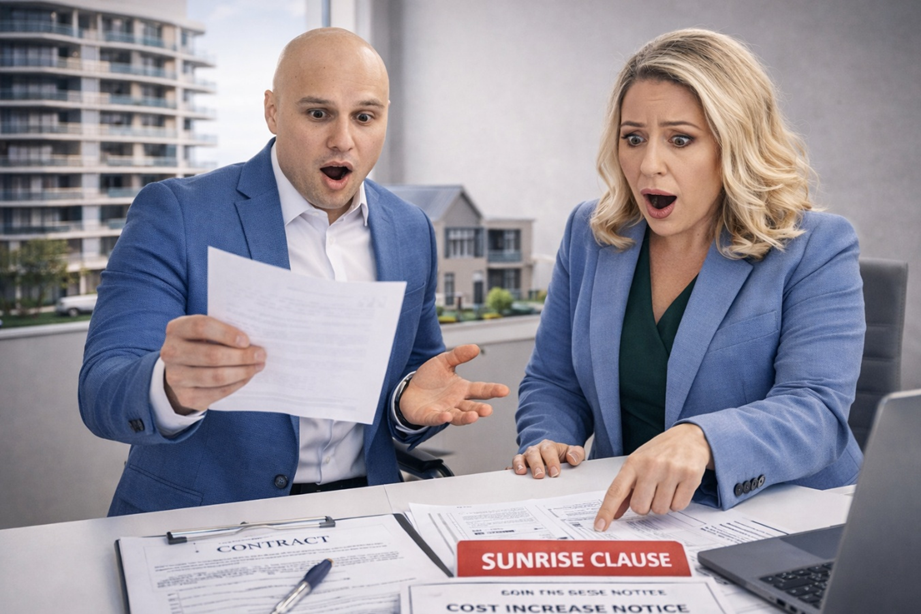
In 2019, NSW law was tightened further so that any “termination event”—not just sunset dates—requires purchaser consent or a Supreme Court order. This closes the “sunrise clause” loophole that Kokoda used in Queensland. If you’re buying off-the-plan in Sydney, this is a huge comfort. It’s very unlikely a developer could pull the same move as Kokoda and get away with it.
Here’s how Queensland and NSW stack up for off-the-plan buyers:
| Feature | Queensland (Ruby Ruby) | New South Wales (Sydney) |
| Termination | Possible via “sunrise” clauses | Restricted by Section 66ZL |
| Automatic Cancellation | Can be automatic | Illegal—must have consent or court order |
| Court Scrutiny | Historically lower | Very high—developer pays costs |
| Price Hikes | Buyers often forced to “pay up or walk” | Developers rarely win the right to “rebuy” at higher prices |
The Kokoda Property disaster in Brisbane is a wake-up call for all Australians. Buying off-the-plan means you’re tied to the developer’s success—and their failures. However, if you’re buying in NSW, you have a powerful shield in the Supreme Court. Section 66ZL was designed exactly for this: to stop developers from treating your contract like a “free loan” while they wait for the market to rise.
For anyone looking to buy off-the-plan in areas like Blacktown, The Ponds, Marsden Park, Annangrove, Box Hill, or Stanhope Gardens, here’s the Flash Conveyancing OTP Checklist that Julian and Renee use to stress-test every contract before a client signs:
- The “Sunset” & “Sunrise” Review
- Does the contract allow the developer to extend dates for “any reason” or only limited ones?
- In NSW, check that the contract doesn’t try to sidestep Section 66ZL (it’s not allowed anyway).
- The Disclosure Statement
- Make sure there’s a mandatory Disclosure Statement—with draft plan, finishes, and by-laws—as required in NSW since 2019.
- The 2% Compensation Rule
- If the developer changes something significant (like reducing your apartment size), do you have the right to rescind or claim up to 2% compensation?
- Deposit Protection
- Confirm your deposit is held in a Solicitor’s Trust Account.
- Never allow the deposit to go straight to the developer for construction costs.
- The 10-Day Cooling Off Period
- Off-the-plan buyers in NSW get 10 business days (not 5) to sort finance and building reports. Don’t waste a minute of it.
When you put Queensland and NSW side by side, the difference is stark. In Queensland, developers can use sunrise clauses to rescind with minimal notice, deposits are generally safe but less tightly controlled, and buyers are exposed to “cancel and resell” tactics. In NSW, developers face strict rescission rules, must give 28 days’ notice, and can only cancel with your consent or a court order. Deposit security is stronger and, most importantly, you’re protected from developers profiteering at your expense.
Flash Conveyancing, led by Julian & Renee, are specialists in property transactions across the whole of NSW. With deep experience navigating local councils like Blacktown, Hawkesbury, Blue Mountains, The Hills, Hornsby, and Parramatta, they bring a personalized touch to every settlement—serving communities from Acacia Gardens, Marsden Park, and The Ponds to Northmead, Norwest, and beyond.
Our team has a proven track record of working seamlessly with the Blacktown, Hawkesbury, Blue Mountains, The Hills Shire, Hornsby, and Parramatta councils.
North-West Growth Corridor: Marsden Park, Box Hill, Schofields, Tallawong, Riverstone, Gables, Melonba, Grantham Farm, and Angus.
The Hills District & Surrounds: Castle Hill, Kellyville, North Kellyville, Bella Vista, Baulkham Hills, Beaumont Hills, Norwest, Rouse Hill, Winston Hills, and Westmead.
Blacktown City & Established West: Blacktown, Seven Hills, Glendenning, Glenwood, Stanhope Gardens, The Ponds, Quakers Hill, Kings Langley, Parklea, Acacia Gardens, Arndell Park, Rooty Hill, and Doonside.
Hawkesbury & Lifestyle Estates: Dural, Middle Dural, Kenthurst, Glenhaven, Galston, Glenorie, Annangrove, Nelson, Cattai, Maraylya, Vineyard, and Windsor.
Parramatta & Emerging Hubs: Parramatta, Northmead, North Rocks, North Parramatta, Wentworthville, and St Marys.