

By Julian & Renee (Australia) – with writing support from Alberto Aldana (Colombia)
In the landmark case of Ceerose Pty Ltd v The Owners – Strata Plan No 89074 [2025] NSWCA 235, the NSW Court of Appeal has reshaped how building defects are approached in New South Wales. The ruling challenges the previous assumption that builders have an automatic right to return and rectify their own defective work—an approach that often disadvantaged property owners. This decision represents a significant step toward greater builder accountability.
The Real Story Behind “The Eliza”
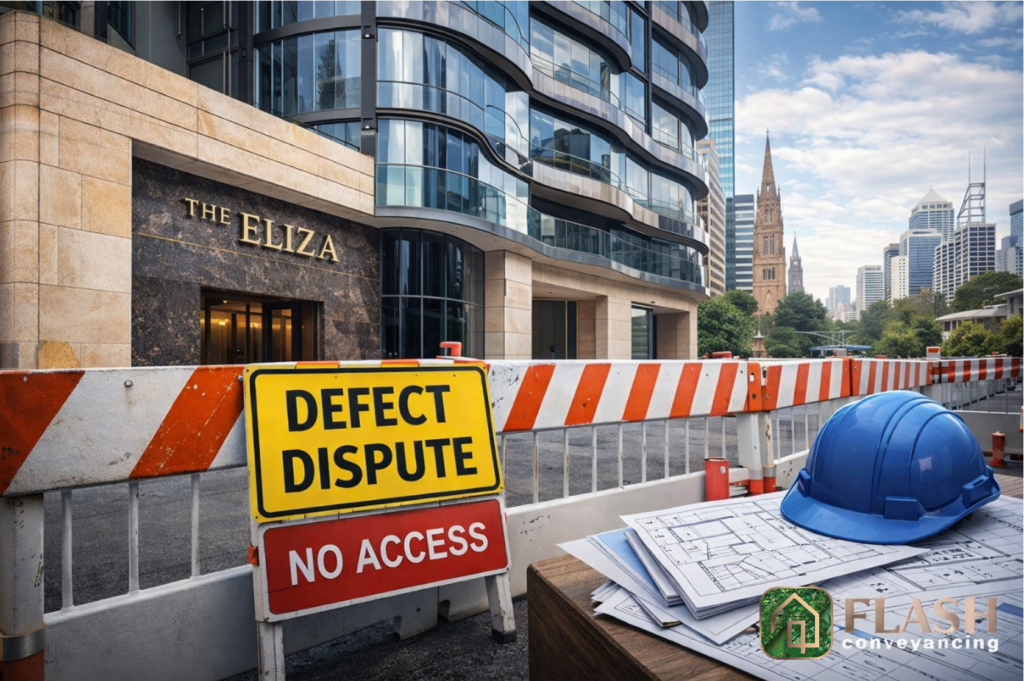
The Ceerose case concerned a luxury apartment building known as “The Eliza” in Sydney’s CBD. After its completion in 2014, serious defects were identified, including issues with bathroom drainage and the lift shaft. The Owners Corporation (OC) attempted for years to work with the builder, Ceerose, but eventually lost confidence in its ability to properly rectify the defects. As a result, the OC denied the builder further access to the site and engaged alternative contractors to complete the repairs.
Ceerose argued that by refusing access, the OC failed to “mitigate” its loss. The builder claimed it could have completed the repairs at a lower cost and that the OC’s decision increased the overall expense. The Court of Appeal clarified several key principles relevant to strata owners:
- There is no automatic right for a builder to return and rectify defects. At common law, there is no positive obligation requiring an owner to give the builder a second opportunity.
- Once a builder has failed to meet the required standard, the owner may engage alternative contractors to carry out the repairs.
- The burden now rests on the builder to prove that the owner acted unreasonably in refusing access.
The Court also recognised that it can be reasonable for an owner to refuse access where there is a history of defective work, delays, or lack of confidence in the builder’s ability to rectify the issues.
Why This Is a Game Changer
This decision significantly alters the balance of power in defect disputes. Previously, builders could pressure owners into allowing them back on site by arguing that refusal would reduce or defeat the owner’s claim for damages.
The Ceerose ruling limits that argument. Owners are no longer at risk of automatically losing their claim simply because they refused access, particularly where the refusal is reasonable. The Court outlined factors relevant to determining whether an owner’s refusal is reasonable, including:
- The seriousness of the defects
- The quality of the builder’s previous repair attempts
- Whether the builder has demonstrated a genuine commitment to resolving the issues
- Whether ongoing negotiations have broken down
This framework provides greater clarity and protection for property owners, allowing them to avoid being forced into accepting inadequate repairs.
Practical Guidance for Owners
Despite the ruling, property owners should proceed carefully. It is generally advisable to provide the builder with one clear and reasonable opportunity to rectify the defects. However, if the builder fails to meet the required standard, owners can now rely on the Ceerose decision to refuse further access and engage independent experts to complete the work. Where disputes arise, owners may still need to pursue resolution through mechanisms such as the NSW Civil and Administrative Tribunal (NCAT). While this can involve time and cost, it remains an important avenue for enforcing legal rights.
Flash Conveyancing assists clients with property transactions across New South Wales. Julian and Renee provide support in navigating defect issues and protecting property rights throughout the process. With extensive experience working with local councils including Blacktown, Hawkesbury, Blue Mountains, and Parramatta, their team offers a tailored approach to each matter. If you are involved in a property transaction or facing a building defect dispute, seeking early advice can help protect your legal and financial position.
Our team has a proven track record of working seamlessly with the Blacktown, Hawkesbury, Blue Mountains, The Hills Shire, Hornsby, and Parramatta councils.
North-West Growth Corridor: Marsden Park, Box Hill, Schofields, Tallawong, Riverstone, Gables, Melonba, Grantham Farm, and Angus.
The Hills District & Surrounds: Castle Hill, Kellyville, North Kellyville, Bella Vista, Baulkham Hills, Beaumont Hills, Norwest, Rouse Hill, Winston Hills, and Westmead.
Blacktown City & Established West: Blacktown, Seven Hills, Glendenning, Glenwood, Stanhope Gardens, The Ponds, Quakers Hill, Kings Langley, Parklea, Acacia Gardens, Arndell Park, Rooty Hill, and Doonside.
Hawkesbury & Lifestyle Estates: Dural, Middle Dural, Kenthurst, Glenhaven, Galston, Glenorie, Annangrove, Nelson, Cattai, Maraylya, Vineyard, and Windsor.
Parramatta & Emerging Hubs: Parramatta, Northmead, North Rocks, North Parramatta, Wentworthville, and St Marys.