

By Julian & Renee (Australia) – with writing support from Alberto Aldana (Colombia)
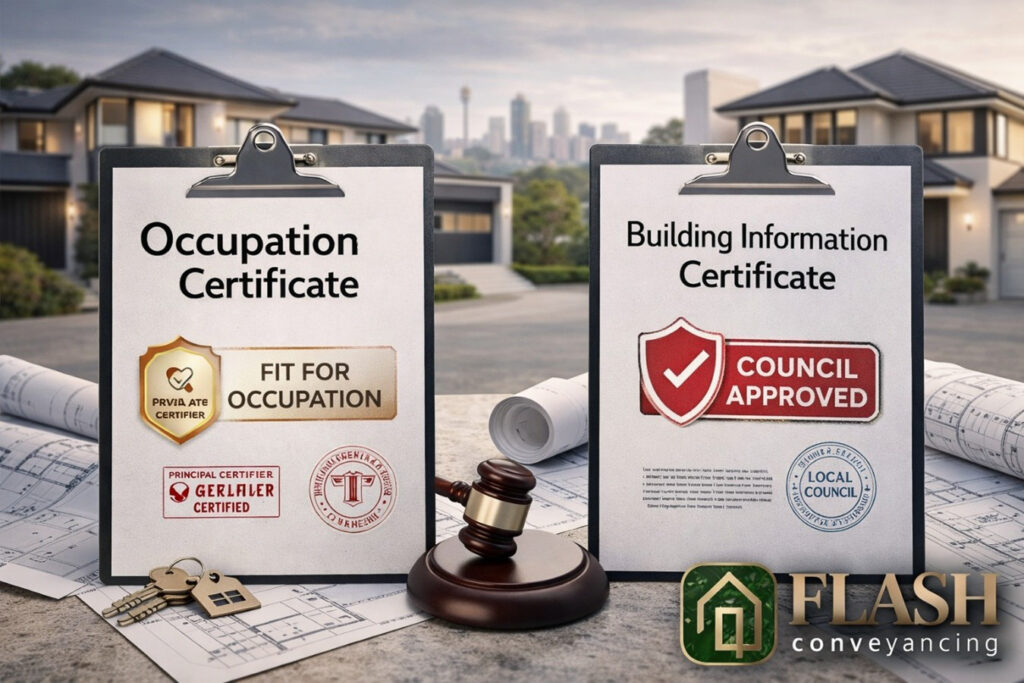
In the property market of New South Wales, two certificates that are often confused are the Occupation Certificate (OC) and the Building Information Certificate (BIC). However, these certificates are quite different. Both vendors and purchasers need to understand the roles these certificates play in the conveyancing process. In this article, we examine the differences and why both certificates matter in property transactions.
The Occupation Certificate (OC) acts like a “birth certificate” for a newly constructed building, indicating that it is safe to occupy. The OC is issued by the principal certifier (either a council or private certifier) and is required before anyone can legally live in or use a building.
For buyers, the OC confirms that the property is legally habitable and safe for occupation. For sellers, obtaining the OC is essential because the vendor generally cannot require the purchaser to settle or take possession of brand-new property without it. The OC process often includes supporting documents such as Fire Safety Certificates, BASIX Certificates, and compliance certificates from relevant trades.
The Building Information Certificate (BIC), on the other hand, acts more like an “insurance policy” against council enforcement action. This certificate is issued by the local council and provides protection from certain regulatory actions (such as demolition orders) for a period of seven years.
A BIC is commonly sought when building works have been completed without the required approvals or completion certificates. For example, when an older property includes extensions or modifications that were constructed without proper approval, obtaining a BIC may help provide reassurance to a purchaser. For vendors, obtaining a BIC can help address concerns about unapproved works and make the property easier to sell by reducing the risk of council action.
The two certificates serve very different purposes. An Occupation Certificate confirms that a building is safe to occupy and complies with relevant approvals. In contrast, a Building Information Certificate simply protects against council enforcement action for unapproved works.
A BIC only confirms that the council will not take certain actions regarding the unauthorised work for a specified period.
Sellers may choose to obtain a BIC for properties with unapproved works to improve saleability and avoid concerns about “illegal works.” However, obtaining a BIC may involve additional costs and documentation, including a registered survey report and council inspections.
Flash Conveyancing, operated by Julian and Renee, specialises in property transactions throughout New South Wales. With extensive experience working with local councils including Blacktown, Hawkesbury, Blue Mountains, The Hills, Hornsby, and Parramatta, we provide a personalised approach to every settlement. Our professionals assist with handling the relevant documentation involved in property transactions, including Occupation Certificates and Building Information Certificates. Whether you are buying, selling, or investing in property in suburbs such as Acacia Gardens, Stanhope Gardens, Windsor, Kellyville, or Castle Hill, we help ensure that your property transaction proceeds smoothly without delays caused by missing or incorrect documentation.
Our team has a proven track record of working seamlessly with the Blacktown, Hawkesbury, Blue Mountains, The Hills Shire, Hornsby, and Parramatta councils.
North-West Growth Corridor: Marsden Park, Box Hill, Schofields, Tallawong, Riverstone, Gables, Melonba, Grantham Farm, and Angus.
The Hills District & Surrounds: Castle Hill, Kellyville, North Kellyville, Bella Vista, Baulkham Hills, Beaumont Hills, Norwest, Rouse Hill, Winston Hills, and Westmead.
Blacktown City & Established West: Blacktown, Seven Hills, Glendenning, Glenwood, Stanhope Gardens, The Ponds, Quakers Hill, Kings Langley, Parklea, Acacia Gardens, Arndell Park, Rooty Hill, and Doonside.
Hawkesbury & Lifestyle Estates: Dural, Middle Dural, Kenthurst, Glenhaven, Galston, Glenorie, Annangrove, Nelson, Cattai, Maraylya, Vineyard, and Windsor.
Parramatta & Emerging Hubs: Parramatta, Northmead, North Rocks, North Parramatta, Wentworthville, and St Marys.